From noon until three in the afternoon darkness came over all the land. About three in the afternoon Jesus cried out in a loud voice, “Eli, Eli, lema sabachthani?” (which means “My God, my God, why have you forsaken me?” (Mt 27)
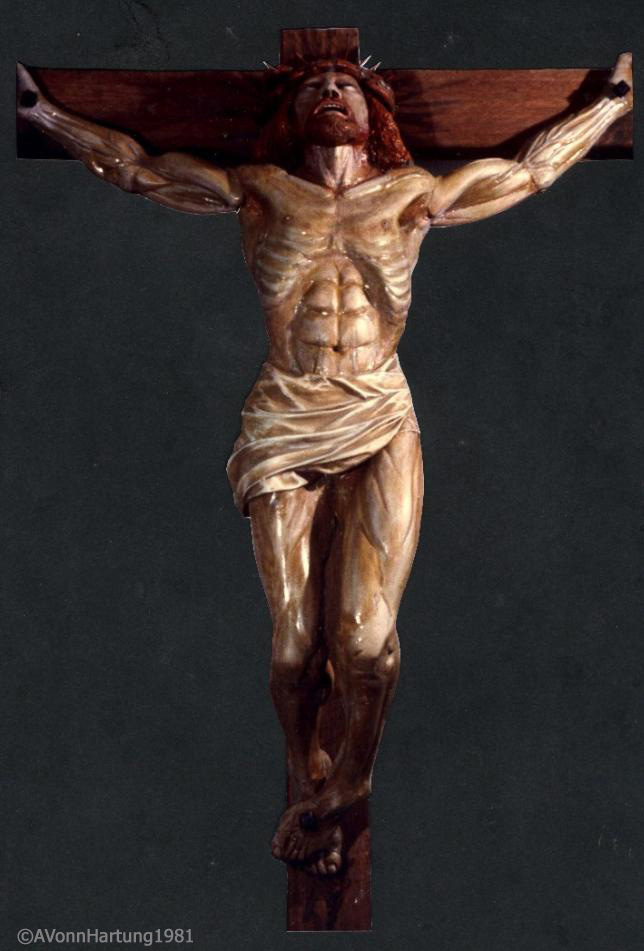
I carved this crucified Christ, “The Agony of Crucifixion” after an in-depth study of the book A Doctor at Calvary by Pierre Barbet M.D., a forensic pathologist’s analysis of the Holy Shroud of Turin. It reveals a graphic account of Jesus’s suffering at the hands of the Romans. “A theory attributed to Pierre Barbet holds that, when the whole body weight was supported by the stretched arms, the typical cause of death was asphyxiation. He wrote that the condemned would have severe difficulty inhaling, due to hyper-expansion of the chest muscles and lungs. The condemned would therefore have to draw himself up by the arms, leading to exhaustion, or have his feet supported by tying or by a wood block. When no longer able to lift himself, the condemned would die within a few minutes.”
The main results of the study show in the carving the effects of asphyxiation symptoms where all the muscles of the body cramp up due to lack of oxygen and cause massive cramps resulting in agonizing death.
So precise was this macabre form of torture and death, that in the way the Romans hung the bodies to the cross they could determine how long it would take the victim to die.
Msgr. Bronislaw Gadarowski commissioned this life-size wood sculpture for St. John’s Catholic Church in Montville, Connecticut. The artist carved it in linden wood (circa 1981)
NOTE—I remember when I returned to the church a few days after it was installed; it had to be in maybe 1983. When I walked into the church there were at least five people on their knees looking up at the crucifix; they were Polish second generation faithful. A short time afterwards, the priest told me that they were thinking about taking it down and only putting it up during Lent because some parents said it scared their children! Two years later when I visited the church during Lent; there was a newly installed Priest—I think he was from Quebec. I told him about the incident with the Kids. He looked at me and said, “I sit underneath it. I worry it might fall on me.” So it has some provenance!
Two contemplative videos (English and Spanish versions) showing the Passion of our Lord Jesus Christ (his arrest, taking up of the cross, crucifixion, death and burial) through original paintings and wood sculptures by the artist A.Vonn Hartung, accompanied by meditative music.
Español
La Agonía de la Crucifixión
LA AGONÍA DE LA CRUCIFIXIÓN
Desde el mediodía hasta las tres de la tarde, la oscuridad cubrió toda la tierra. Alrededor de las tres de la tarde, Jesús clamó a gran voz: «Elí, Elí, ¿lema sabactani?» (que significa “Dios mío, Dios mío, ¿por qué me has abandonado?” (Mt 27)
Tallé este Cristo crucificado, «La agonía de la crucifixión», tras un estudio exhaustivo del libro «Un médico en el Calvario» del Dr. Pierre Barbet, un análisis forense de la Sábana Santa de Turín. Este libro ofrece una descripción gráfica del sufrimiento de Jesús a manos de los romanos. «Una teoría atribuida a Pierre Barbet sostiene que, cuando todo el peso del cuerpo recaía sobre los brazos extendidos, la causa típica de muerte era la asfixia. Escribió que el condenado tendría graves dificultades para respirar debido a la hiperexpansión de los músculos del pecho y de los pulmones. Por lo tanto, el condenado tendría que incorporarse apoyándose en los brazos, lo que le provocaría agotamiento, o bien, sus pies serían sostenidos mediante ataduras o un bloque de madera. Al no poder levantarse por sí mismo, el condenado moriría en pocos minutos».
Los principales resultados del estudio muestran, en el tallado, los efectos de los síntomas de asfixia, en los que todos los músculos del cuerpo se contraen debido a la falta de oxígeno y provocan calambres masivos que resultan en una muerte agonizante.
Tan precisa era esta macabra forma de tortura y muerte que, al colgar los cuerpos de la cruz, los romanos podían determinar cuánto tardaría en morir la víctima.
Monseñor Bronislaw Gadarowski encargó esta escultura de madera de tamaño natural para la iglesia católica de San Juan en Montville, Connecticut. El artista la talló en madera de tilo (alrededor de 1981).
NOTA: Recuerdo cuando volví a la iglesia unos días después de su instalación; debió ser en 1983, más o menos. Al entrar, había al menos cinco personas arrodilladas mirando el crucifijo; eran fieles polacos de segunda generación. Poco después, el sacerdote me comentó que estaban pensando en quitarlo y solo colocarlo durante la Cuaresma, porque algunos padres decían que asustaba a sus hijos! Dos años más tarde, cuando visité la iglesia durante la Cuaresma, había un sacerdote recién nombrado; creo que era de Quebec. Le conté lo sucedido con los niños. Me miró y me dijo: «Yo me siento debajo. Me preocupa que se me caiga encima». ¡Así que tiene cierta historia!
Un video contemplativo, con texto en español, especialmente adecuado para la contemplación y la oración del Viernes Santo acompañado de música meditativa, que muestra la Pasión de nuestro Señor Jesucristo (su arresto, toma de la cruz, crucifixión, muerte y entierro) a través de pinturas originales y esculturas en madera del artista A.Vonn Hartung.