“…and so I tell you, Peter: you are a rock, and on this rock foundation I will build my church, and not even death will ever be able to overcome it. I will give you the keys of the Kingdom of heaven; what you prohibit on earth will be prohibited in heaven, and what you permit on earth will be permitted in heaven.” (Matthew 16:18-19)
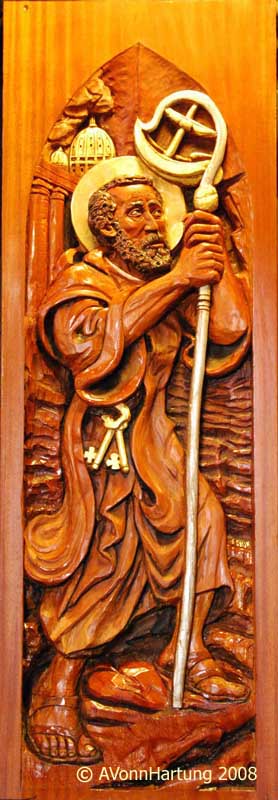
“St. Peter” wood sculpture high relief by AVonnHartung for St. Paul’s Catholic Church (Pensacola, Florida)
Artistically, I have tried through composition and subject matter to place St. Peter in the center of his mission. I have strived to impart a feeling of the harmony brought to him through the gift of the Holy Spirit. In his countenance as a man, I show his strength and vulnerability as well as the dynamic quality of his inspiration.
I express Peter’s great humanity by portraying his sensitive concern for his emotional and idealistic vulnerability, as well as his tight grip on the immense task laid upon him.
He is a man of our times, for he is still with us through the sacred succession of popes. I express this in the dome of Saint Peter’s and the columns of his basilica in the background.
His garments show him as a fisherman and a priest, with both his hood and stola shown against the sea where he fished. He holds the shepherd’s staff with the first ambo from which Jesus preached, which was Peter’s boat. Also on the staff is planet Earth, God’s sacred creation, we call home.
Also emphasized are the keys to heaven and the Holy Spirit in the wind of his garments. He stands upon the rock of Christ’s church, which I have placed emerging from the sea of time and human history, and resembling somewhat the surface of the human heart.
This high relief wood sculpture (12-inches x 33-inches x 3-inches) is one of six saints carved by A.Vonn Hartung for the Ambo of St. Paul’s Catholic Church in Pensacola, Florida. Pastor Doug Halsema commissioned these carvings through Liturgical Consultant Dr. Steven Schloeder of Liturgical Environs.
The carvings considered as a group: Because Christ is present in His own word in proclaiming the Gospel the carved figures of the saints Peter, Paul, and the Evangelists are all directed towards the center of the Ambo. It is as if they are again listening to and reliving the truth and reality of Christ Jesus. Because of them and through them, the gift of the Holy Spirit continues to live in us in the Liturgy of the Word.
Here are large photos, including a bilingual (Eng/Span) description of the Ambo and all six saints—
Six Carved Saints is a video of the artist explaining the symbolism of the six carvings.
“Working with Vonn on the iconography and formal expression of the new ambo at St. Paul’s in Pensacola, Florida, was an enriching experience. Vonn brought forth a powerful new interpretation of a classical iconographic theme. The four Evangelists surrounding the figures of Saints Peter and Paul create a “sacra conversazione” of dialogue among themselves, with the Lord, who proclaims the Gospel, and with the congregation listening to the Lord proclaimed in the Gospel. The power of his figures that capture the spirit of the Evangelists and the Apostles of Rome can only come from deep contemplation and resonance with the subjects, and a profound mastery of his art.” —Dr. Steven J. Schloeder, architect, author of Architecture in Communion (Ignatius Press)
**************************************
Español
“…y yo te digo que tú eres Pedro. Sobre esta piedra edificaré mi iglesia y las puertas de los dominios de la muerte no prevalecerán contra ella. Te daré las llaves del reino de los cielos; todo lo que ates en la tierra quedará atado en el cielo y todo lo que desates en la tierra quedará desatado en el cielo.” (Mateo 16: 18-19)
“San Pedro“, Escultura en madera, altorrelieve, de AVonn Hartung, para la Iglesia Católica, Saint Paul (Pensacola, Florida).
Artísticamente, he intentado, mediante la composición y la temática, situar a San Pedro en el centro de su misión. Me he esforzado por transmitirle la sensación de la armonía que le trajo el don del Espíritu Santo. En su rostro humano, muestro su fuerza y vulnerabilidad, así como el dinamismo de su inspiración.
Expreso la gran humanidad de Peter al retratar su sensible preocupación por su vulnerabilidad emocional e idealista, así como su firme compromiso con la inmensa tarea que se le había encomendado.
Es un hombre de nuestro tiempo, pues sigue con nosotros a través de la sagrada sucesión de los papas. Lo expreso en la cúpula de San Pedro y en las columnas de su basílica al fondo.
Sus vestimentas lo muestran como pescador y sacerdote, con su capucha y su estola contra el mar donde pescaba. Sostiene el cayado de pastor con el primer ambón desde el que predicó Jesús, que era la barca de Pedro. También en el cayado está el planeta Tierra, la creación sagrada de Dios, que llamamos hogar.
También se destacan las llaves del cielo y el Espíritu Santo en el viento de sus vestiduras. Él se yergue sobre la roca de la iglesia de Cristo, que he colocado emergiendo del mar del tiempo y la historia humana, y que se asemeja en cierta medida a la superficie del corazón humano.
Esta escultura de madera en alto relieve (12 pulgadas x 33 pulgadas x 3 pulgadas) es uno de los seis santos tallados por A. Vonn Hartung para el ambón de la iglesia católica de San Pablo en Pensacola, Florida. El pastor Doug Halsema encargó estas esculturas a través del consultor litúrgico Dr. Steven Schloeder de Liturgical Environs.
Las tallas consideradas como un grupo: Porque Cristo está presente en Su propia palabra al proclamar el Evangelio, las figuras talladas de los santos Pedro, Pablo y los Evangelistas están todas dirigidas hacia el centro del Ambón. Es como si estuvieran nuevamente escuchando y reviviendo la verdad y la realidad de Cristo Jesús. Por ellos y a través de ellos, el don del Espíritu Santo continúa viviendo en nosotros en la Liturgia de la Palabra.
Aquí hay fotografías grandes, incluida una descripción bilingüe del ambón y de los seis santos.
Six Carved Saints es un vídeo del artista que explica el simbolismo de las seis tallas.
“Trabajar con Vonn en la iconografía y la expresión formal del nuevo ambón de la iglesia de San Pablo en Pensacola, Florida, fue una experiencia enriquecedora. Vonn creó una nueva y poderosa interpretación de un tema iconográfico clásico. Los cuatro evangelistas que rodean las figuras de los santos Pedro y Pablo crean una “sacra conversazione” de diálogo entre ellos, con el Señor, que proclama el Evangelio, y con la congregación que escucha al Señor proclamado en el Evangelio. La fuerza de sus figuras, que capturan el espíritu de los evangelistas y los apóstoles de Roma, solo puede provenir de una profunda contemplación y conexión con los temas, y de un profundo dominio de su arte”. —Dr. Steven J. Schloeder, arquitecto, autor de Architecture in Communion (Ignatius Press)
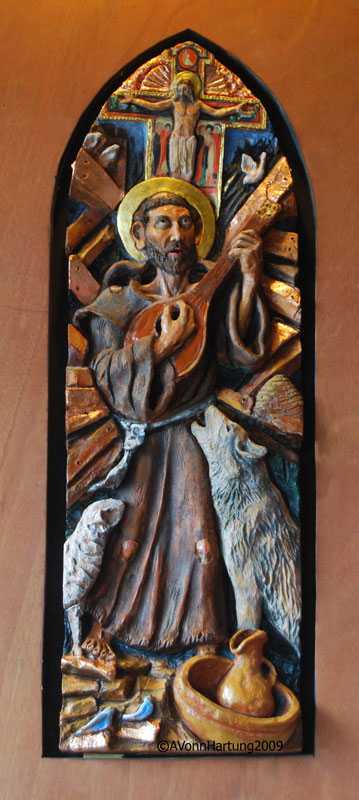
“St. Francis of Assisi” ceramic sculpture by A.Vonn Hartung, commissioned by Ramón Rivera and Julie A. Thomas
St. Francis lived in the Holy Spirit. In a Gothic arch, a sign of the times in which he lived, St. Francis stands among the fallen and broken timbers of the abandoned San Damiano Church, scattered building blocks at his feet and the Cross of Damiano above, surrounded by his beloved birds and animals: the doves, songbirds, the lamb and the wolf symbolizing peace and harmony… the wolf tamed and throating harmony to Francis’ melody played on his lute and sung as Prayer.
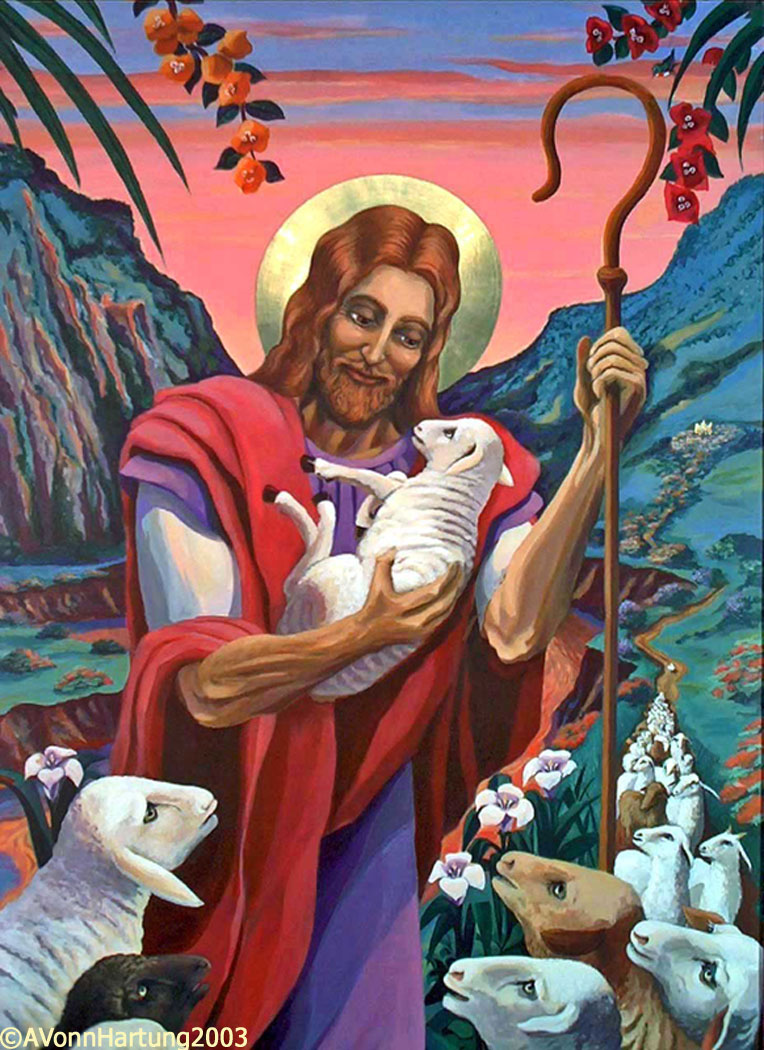
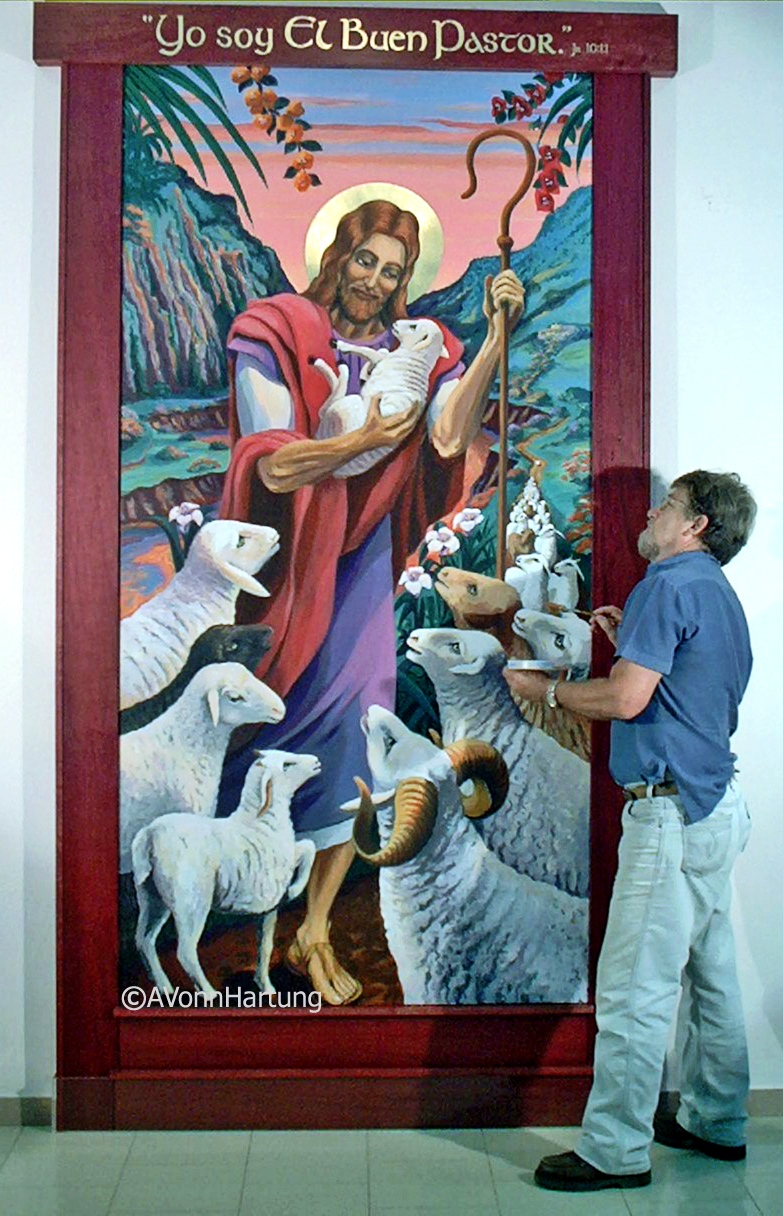
El Buen Pastor / Good Shepherd painting by A.VonnHartung
When Padre Jaime Vázquez commissioned this painting, “El Buen Pastor / The Good Shepherd”, as part of my research I visited Ochoa Agrícola (agricultural store) in Caguas, Puerto Rico. They have scores of sheep, mostly lambs and yearlings.
I worked among them getting close-up sketches and the feel of them.
It is such an important part of bringing what we paint to life, to know as much as possible the essence of what it is we are making visible, which in reality is merely a thin film of paint on a two-dimensional canvas.
Closeup detail of painting “El Buen Pastor” (4 x 8-feet) by AVonnHartung, commissioned by Padre Jaime Vázquez Rojas in 2003 for “Parroquia El Buen Pastor” in Guaynabo (Apolo), Puerto Rico
VIEW THE VIDEO—“My sheep hear my voice, and I know them. They follow me and I give them eternal life… (Jn 10:27) In this video A.Vonn Hartung speaks to a group of parishioners about his painting “El Buen Pastor”— In 2015 the parishioners of his church, San Ignacio de Loyola in Puerto Rico, under the leadership of Dra Señora Laura Gorbea organized a CARAVAN OF CARS to begin to make the rounds to see the Churches with Sacred Art that he had completed. We started with three churches in the metropolitan area. The painting in this video was commissioned by Padre Jaime Vázquez Rojas (may he rest in peace) of the Church of El Buen Pastor on Ave. Apolo in the town of Guaynabo.
NOTE: Due to the low resolution of this video, optimal viewing would be on a smartphone rather than a desktop computer.
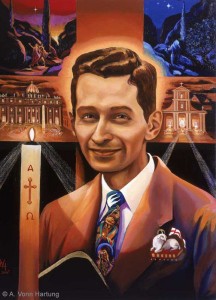
At the core of Blessed Carlos Manuel Rodriguez’ spirituality (Pope John Paul II said) was his faith in the Resurrection. He promoted the Easter Vigil as the defining moment of Christian spiritual life, repeating often, “We live for that night.” (Vivimos para esa Noche)
Blessed Carlos Manuel Rodríguez Oil portrait by A. Vonn Hartung 2001
In 2001 I was deeply honored and humbled to be commissioned by the archbishop of San Juan, Monsignor Roberto González Nieves, to paint the official portrait of Blessed Carlos Manuel Rodríguez. Significantly, it was to be given as a gift from Puerto Rico to the Pontifical North American College in Vatican City. Indeed it is exhibited there in the Hall of Saints.
The Portrait is painted with various symbolic elements. They express a visual prayer that “speaks to the eye”. In other words, what was it that helped bring Blessed Carlos Manuel Rodriguez to such an intimate connectedness to our Lord and Savior? The absolute serenity and joy in Charlie’s look is the faith that we seek. It is the faith that seeks us.
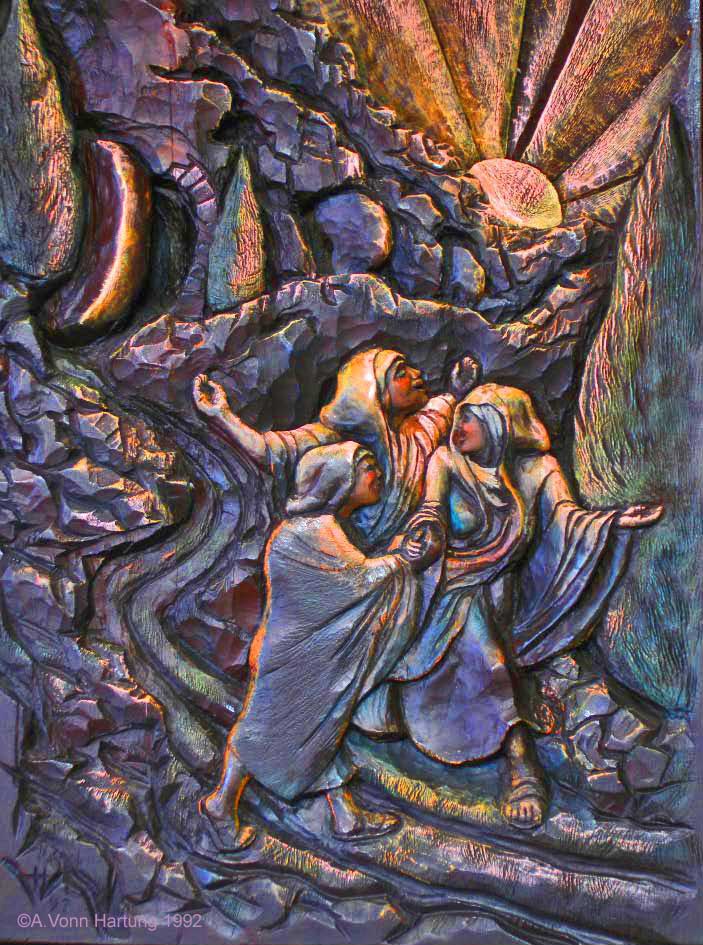
“He is Risen” is a carved tabernacle door depicting the hillside of Jerusalem where Jesus was buried. The rising sun reveals it to be Easter morning as the three women skip down the path together, an expression of great joy upon realizing that Jesus has risen.
The grave is empty, sculpted out to serve as the handle of the door, so each time the priest opens the tabernacle, he must put his hand into the empty tomb.
Commissioned in 1992 by Padre Jorge Castillejo Lluisiá for Casa de Niños Manuel Fernández Juncos, San Juan, Puerto Rico
*************************
“Ha resucitado” es una puerta del tabernáculo tallada que representa la ladera de Jerusalén donde fue enterrado Jesús. El sol naciente revela que es la mañana de Pascua mientras las tres mujeres saltan juntas por el sendero, en una expresión de gran alegría al darse cuenta de que Jesús ha resucitado.
La tumba está vacía, esculpida para servir de manija de la puerta, por lo que cada vez que el sacerdote abre el tabernáculo, debe meter la mano en la tumba vacía.
Encargado en 1992 por el Padre Jorge Castillejo Lluisiá para Casa de Niños Manuel Fernández Juncos, San Juan, Puerto Rico
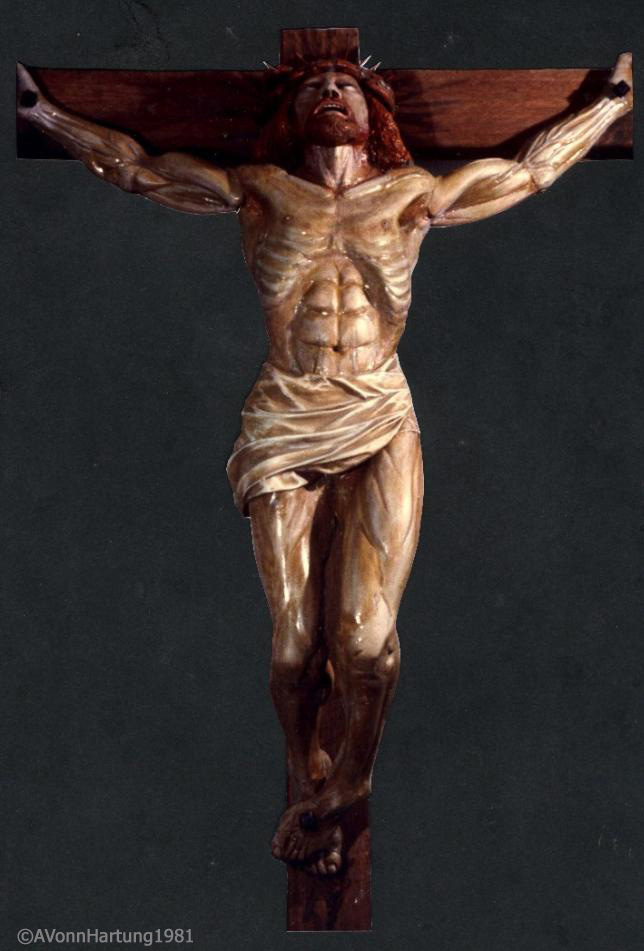
From noon until three in the afternoon darkness came over all the land. About three in the afternoon Jesus cried out in a loud voice, “Eli, Eli, lema sabachthani?” (which means “My God, my God, why have you forsaken me?” (Mt 27)
I carved this crucified Christ, “The Agony of Crucifixion” after an in-depth study of the book A Doctor at Calvary by Pierre Barbet M.D., a forensic pathologist’s analysis of the Holy Shroud of Turin. It reveals a graphic account of Jesus’s suffering at the hands of the Romans. “A theory attributed to Pierre Barbet holds that, when the whole body weight was supported by the stretched arms, the typical cause of death was asphyxiation. He wrote that the condemned would have severe difficulty inhaling, due to hyper-expansion of the chest muscles and lungs. The condemned would therefore have to draw himself up by the arms, leading to exhaustion, or have his feet supported by tying or by a wood block. When no longer able to lift himself, the condemned would die within a few minutes.”
The main results of the study show in the carving the effects of asphyxiation symptoms where all the muscles of the body cramp up due to lack of oxygen and cause massive cramps resulting in agonizing death.
So precise was this macabre form of torture and death, that in the way the Romans hung the bodies to the cross they could determine how long it would take the victim to die.
Msgr. Bronislaw Gadarowski commissioned this life-size wood sculpture for St. John’s Catholic Church in Montville, Connecticut. The artist carved it in linden wood (circa 1981)
NOTE—I remember when I returned to the church a few days after it was installed; it had to be in maybe 1983. When I walked into the church there were at least five people on their knees looking up at the crucifix; they were Polish second generation faithful. A short time afterwards, the priest told me that they were thinking about taking it down and only putting it up during Lent because some parents said it scared their children! Two years later when I visited the church during Lent; there was a newly installed Priest—I think he was from Quebec. I told him about the incident with the Kids. He looked at me and said, “I sit underneath it. I worry it might fall on me.” So it has some provenance!
Two contemplative videos (English and Spanish versions) showing the Passion of our Lord Jesus Christ (his arrest, taking up of the cross, crucifixion, death and burial) through original paintings and wood sculptures by the artist A.Vonn Hartung, accompanied by meditative music.
Español
La Agonía de la Crucifixión
LA AGONÍA DE LA CRUCIFIXIÓN
Desde el mediodía hasta las tres de la tarde, la oscuridad cubrió toda la tierra. Alrededor de las tres de la tarde, Jesús clamó a gran voz: «Elí, Elí, ¿lema sabactani?» (que significa “Dios mío, Dios mío, ¿por qué me has abandonado?” (Mt 27)
Tallé este Cristo crucificado, «La agonía de la crucifixión», tras un estudio exhaustivo del libro «Un médico en el Calvario» del Dr. Pierre Barbet, un análisis forense de la Sábana Santa de Turín. Este libro ofrece una descripción gráfica del sufrimiento de Jesús a manos de los romanos. «Una teoría atribuida a Pierre Barbet sostiene que, cuando todo el peso del cuerpo recaía sobre los brazos extendidos, la causa típica de muerte era la asfixia. Escribió que el condenado tendría graves dificultades para respirar debido a la hiperexpansión de los músculos del pecho y de los pulmones. Por lo tanto, el condenado tendría que incorporarse apoyándose en los brazos, lo que le provocaría agotamiento, o bien, sus pies serían sostenidos mediante ataduras o un bloque de madera. Al no poder levantarse por sí mismo, el condenado moriría en pocos minutos».
Los principales resultados del estudio muestran, en el tallado, los efectos de los síntomas de asfixia, en los que todos los músculos del cuerpo se contraen debido a la falta de oxígeno y provocan calambres masivos que resultan en una muerte agonizante.
Tan precisa era esta macabra forma de tortura y muerte que, al colgar los cuerpos de la cruz, los romanos podían determinar cuánto tardaría en morir la víctima.
Monseñor Bronislaw Gadarowski encargó esta escultura de madera de tamaño natural para la iglesia católica de San Juan en Montville, Connecticut. El artista la talló en madera de tilo (alrededor de 1981).
NOTA: Recuerdo cuando volví a la iglesia unos días después de su instalación; debió ser en 1983, más o menos. Al entrar, había al menos cinco personas arrodilladas mirando el crucifijo; eran fieles polacos de segunda generación. Poco después, el sacerdote me comentó que estaban pensando en quitarlo y solo colocarlo durante la Cuaresma, porque algunos padres decían que asustaba a sus hijos! Dos años más tarde, cuando visité la iglesia durante la Cuaresma, había un sacerdote recién nombrado; creo que era de Quebec. Le conté lo sucedido con los niños. Me miró y me dijo: «Yo me siento debajo. Me preocupa que se me caiga encima». ¡Así que tiene cierta historia!
Un video contemplativo, con texto en español, especialmente adecuado para la contemplación y la oración del Viernes Santo acompañado de música meditativa, que muestra la Pasión de nuestro Señor Jesucristo (su arresto, toma de la cruz, crucifixión, muerte y entierro) a través de pinturas originales y esculturas en madera del artista A.Vonn Hartung.
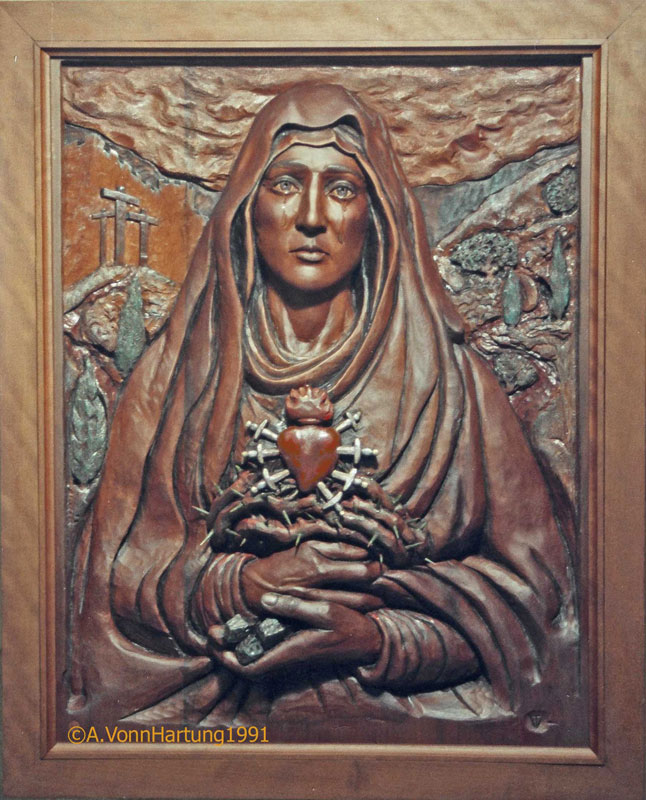
La Madre Dolorosa, a high-relief wood carving, conveys the agony of Jesus through the eyes of his mother, Mary. Specifically, the betrayal by Judas, the arrest, torturous scourging, trial, carrying of the cross, and finally the agonizing crucifixion and death at Golgotha.
The Sorrowful Mother contemplates the seven sorrows of her life, represented by the seven swords piercing her heart.
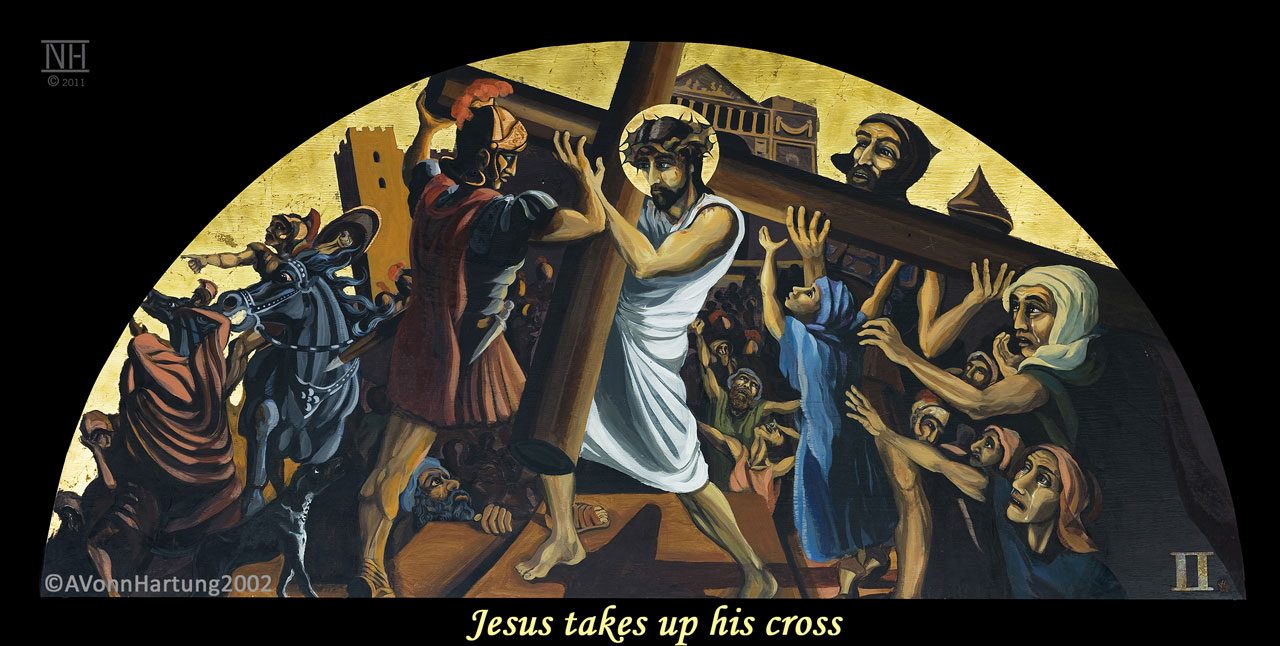
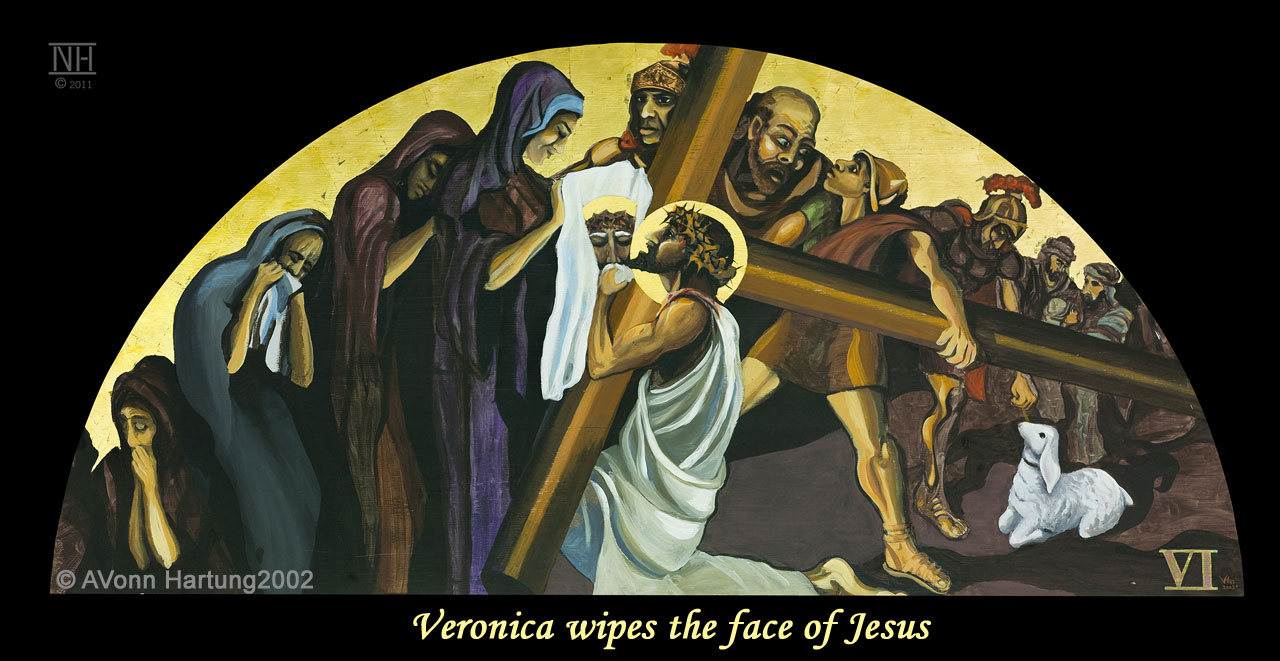
THESE STATIONS OF THE CROSS paintings show the process of conversion as Jesus was put to the test and tormented. Indeed, his persecutors came to understand who he was.
Accordingly, the stations express a perspective that emphasizes the effect Jesus had on those present during his ordeal of carrying his own cross to his crucifixion on Calvary. Specifically, as the bystanders are pulled into his suffering, we follow by observing closely, the actual Revelatory conversion of the principal Roman soldier. Moreover, we see how the outpouring of grief and compassion of others around him begins to melt away his own cruelty and indifference.
See how he marvels at the deep and complete faith of Veronica as she wipes the face of our Lord. Furthermore, others are also going through the steps of conversion from confusion and despair to an awakening clarity. Significantly, we see this most clearly in the others behind Veronica.
Thus we understand how the soldier at the foot of the cross could finally come to the realization that they had indeed crucified “The Son of God”. (Mk 15:39)
About the paintings
The artist painted these Stations of the Cross for Santa Rosa de Lima Church in Guaynabo (Barrio Amelia), Puerto Rico. In fact, he conceived them with the community in mind. Moreover they include much of the spiritual and cultural qualities of Puerto Rico. Each Station measures 4-ft by 8-ft, painted in acrylic and gilded in copper and gold. They surround and crown the nave of the church.
Las pinturas de estas ESTACIONES DE LA CRUZ muestran el proceso de conversión cuando Jesús fue puesto a prueba y atormentado. Sus perseguidores llegaron a comprender quién era.
De hecho, las estaciones expresan una perspectiva que hace hincapié en el efecto que Jesús tuvo en los presentes durante su terrible experiencia de llevar su propia cruz a su crucifixión en el Calvario. A medida que los transeúntes son arrastrados a su sufrimiento, seguimos observando de cerca la conversión Revelatoria real del principal soldado romano. Vemos cómo el torrente de dolor y compasión de los que le rodean comienzan a disipar su propia crueldad e indiferencia.
Vea cómo se maravilla de la fe profunda y completa de Verónica mientras limpia el rostro de nuestro Señor. Otros también están pasando por los pasos de conversión de la confusión y la desesperación a una claridad que despierta, como se ve más visiblemente en los otros detrás de Verónica.
Así entendemos cómo el soldado al pie de la cruz pudo finalmente darse cuenta de que habían crucificado al “Hijo de Dios”. (Marcos 15:39)
Acerca de las pinturas
Estas Estaciones de la Cruz fueron pintadas para la Iglesia Santa Rosa de Lima en Guaynabo (Barrio Amelia), Puerto Rico. El artista los concibió con la comunidad en mente e incluyen gran parte de las cualidades espirituales y culturales de Puerto Rico. Cada estación mide 4 pies por 8 pies, pintada en acrílico y dorada en cobre y oro. Se rodean y coronan la nave de la iglesia.