Catholic Sacred Art

Así en la Tierra Como en El Cielo

Dando respuesta al llamado del Santo Padre, Papa Francisco, al diálogo y a la acción sobre el cambio climático en su encíclica “Laudato Si’, sobre el Cuidado de la Casa Común”, publicado en 2015, ofrezco esta pintura metafórica, “Así en la Tierra Como en El Cielo” (una oración visual) como una contribución al proceso de concienciación y para avivar el diálogo.

Compre una impresión giclée de esta pintura.

[Read in English]
Así en la Tierra como en el Cielo

El título de la pintura Así en la Tierra como en el Cielo surge de la oración que Cristo Jesús nos enseñó, el Padre Nuestro, “Venga A Nosotros Tu Reino, Hágase Tu Voluntad, Así en la Tierra Como En El Cielo”

La pintura presenta un concepto retórico y nos ofrece solamente dos posibilidades.

La primera está en armonía con la Creación de Dios, un futuro de justicia, paz y sustentabilidad en el mundo natural. La segunda conlleva saqueo, caos, guerra interminable y un derrumbamiento final de la naturaleza y de la vida en nuestro hogar planeta como lo hemos conocido hasta ahora.

La pintura interroga y confronta al observador, a cada uno, irrespectivamente de su religión o creencia, ¿en cuál ambiente queremos vivir y dejar a nuestros hijos y a las generaciones futuras?


Dios nos está dando una opción.

Desde la perspectiva cristiana, Dios nos dió el libre albedrío cuando en el jardín del Edén le permitió a Adán escoger si comía o no del fruto prohibido (Gen. 2,16) además de haberle dado consciencia e inteligencia. Adán escogió no escuchar a Dios y le desobedeció.

Dios nos dió una segunda oportunidad al enviarnos a Su Hijo Jesucristo a redimirnos de nuestros pecados. Una vez más no le escuchamos; y nosotros  (la humanidad) la élite  poderosa y los desinformados le rechazamos y crucificamos.

Ahora, Dios, de nuevo nos está ofreciéndonos otra oportunidad, hablándonos a través de su Vicario en la tierra, el Papa Francisco, desde la creación en la espantosa extinción de las especies desde los orígenes de la revolución industrial, los eventos horrendos resultantes del cambio climático, el sufrimiento de los pobres y nuestras guerras interminables.

¿Una vez más NO ESCUCHAREMOS a Dios, no haremos Su voluntad si no la nuestra? Le ignoraremos y continuaremos nuestro tonto y destructivo caminar hacia la aniquilación?


San Francisco nos llama.

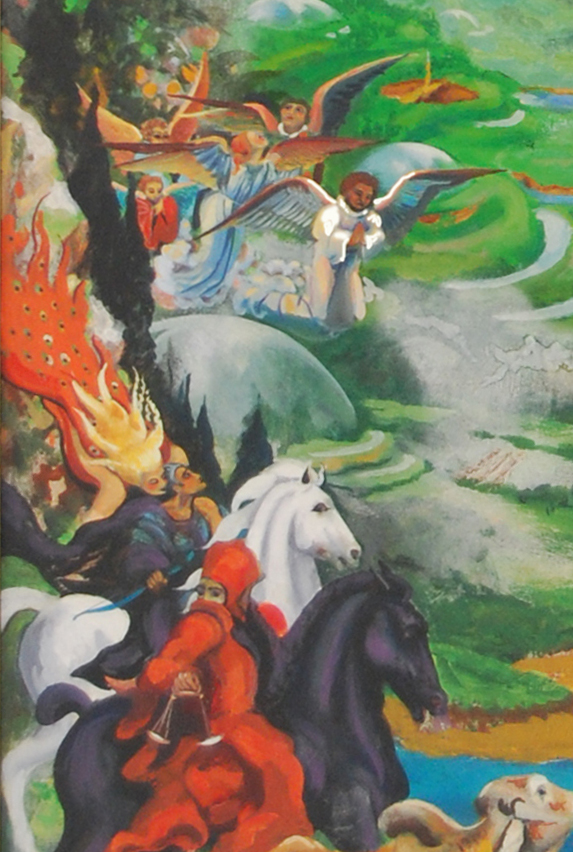
En su encíclica, el Papa Francisco nos habla de San Francisco de Asís cuyo nombre tomó cuando lo hicieron Pontífice, y nombraba al Santo ‘como el Santo Patrón de todos los que estudian y trabajan en el área de ecología’ (L.S.10). Así es que vemos a San Francisco en primer plano de la pintura junto al buey fiel, símbolo del evangelio de San Lucas y los Hechos de los Apóstoles  quienes nos ofrecen el espectáculo y nos hacen conscientes de la opción crucial que se nos presenta, una decisión que tenemos que tomar.

Nuestra decisión nos hace preguntarnos que si nosotros desenfrenadamente destruimos la sagrada creación de Dios por nuestra auto-decepción, apatía, orgullo o avaricia; ¿no estaríamos blasfemando contra Dios y no sería esto como el pecado de Lucifer, el ángel favorito de Dios que cayó por su envidia y orgullo, atreviéndose a retar y rebelarse ante El?

Detail of painting "Así en la Tierra como en el Cielo" by AVonnHartung

Las metáforas del huevo y el oro

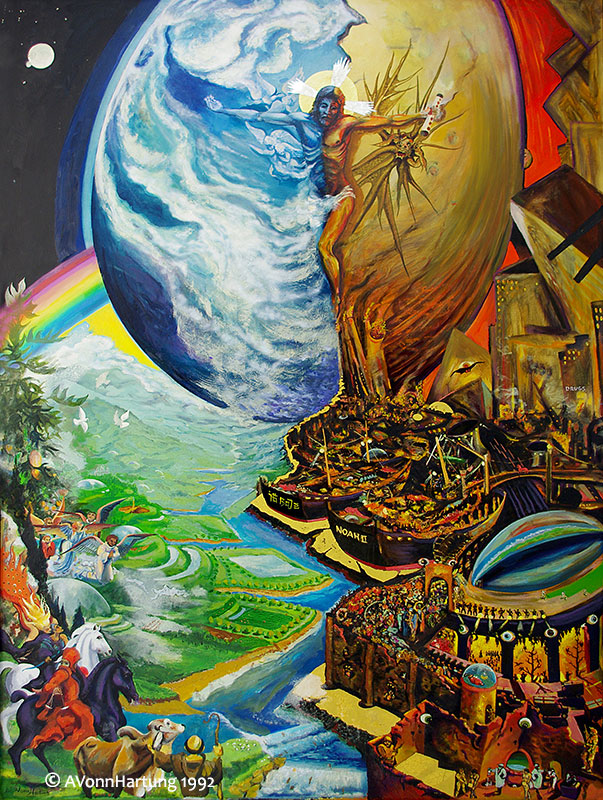
En el centro de la pintura vemos el planeta Tierra, “Nuestra Casa Común” en un lado un estado vivible, saludable, vibrante y mientras que en el otro lado es lugar árido, inhabitable y mortalmente estéril.
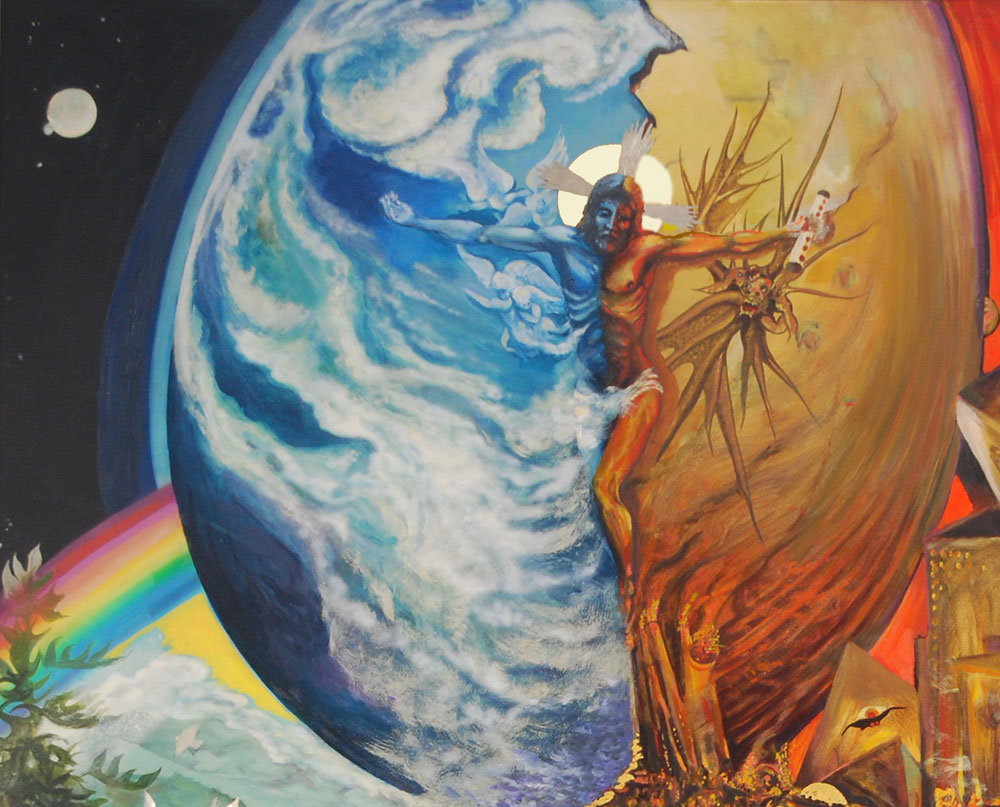
Sobreimpuesto a la Tierra está Cristo, el Centro de la Creación “En El todas las cosas fueron hechas” (Juan 1,3). En Su mano derecha extendida sostiene siete estrellas, símbolo de Esperanza, más arriba hacia Su derecha, nuestra habitación de la luna significando un futuro de infinitas posibilidades.

En la otra mano, no obstante, Cristo agarra el pergamino sellado del Apocalipsis, detrás del que se ven las temidas plagas que serán descargadas si se rompieran los sellos.

La Tierra es pintada en forma ovalada, simbolizando metafóricamente la fragilidad del ecosistema de la Tierra así como su abundancia y fertilidad natural.

La metáfora del huevo también representa la rotura de la alianza y así la ruptura resultante de la frágil ecología y la caída de la humanidad de la gracia causada por un sistema económico lineal defectuoso basado en el mal uso del poder y de las riquezas, simbolizado en el uso impío del oro.

En el simbolismo cristiano el Oro tradicionalmente se ha utilizado para representar la Luz Increada de Dios, la divinidad, como en las aureolas de los santos y en la pintura, la aureola de Cristo.

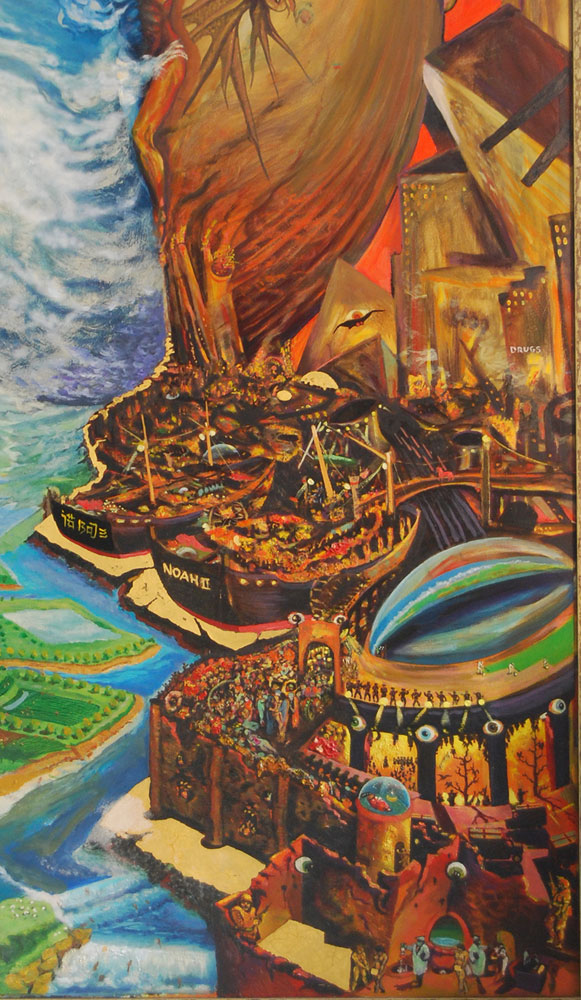
El oro lo hemos utilizado aquí en la parte inferior de la pintura como si gotereara de la hendidura del huevo o centelleante como relámpago para simbolizar la envidia y la avaricia que desea y logra un dominio y control ulterior de los recursos y riquezas del mundo y que define la fractura y el Muro de Separación entre los dos futuros posibles.
Detail2 of painting "Así en la Tierra como en el Cielo" by AVonnHartung

La Tierra está contaminada por su gente.

Detrás de este Muro de Separación que parece gritar con dolor y quejas, se extiende un mundo que colapsa pintado en un conjunto de colores siena de edificios sombreados y quemados que se derrumban unos contra otros.

Doquier se evidencia la violencia (Isaías 24,5) ‘La tierra está profanada bajo sus habitantes que violaron la ley, trastocaron el decreto, rompieron el pacto perpetuo.’


Burbujas de biósfera exclusivas

Entre las estructuras de terrenos desolados están las pirámides que nos recuerdan el culto de los muertos y una cúpula majestuosa dominante de una bioesfera que recuerda el intento de crear un espacio terrestre habitable contrapuesto a la exploración del espacio sideral habitable viable en la estación lunar.

Esta bioesfera sugiere que el único espacio para vivir que se pueda lograr en un futuro lugar tan inservible pudiera ser viviendas altamente custodiadas y privatizadas de los más acaudalados.

Rodeando esta ‘’Burbuja” está la evidencia del precio que pagamos por sostener esta empresa exclusiva y segura, un comercio de esclavitud custodiado por dominio bruto y alimentado por el intercambio (tráfico) de partes del cuerpo humano y tejidos de los desaparecidos a través de los horrores de la deshumanización.

Los siete pecados mortales están implicados aunque velados parcialmente por el uso de la abstracción lo cual aduce a la pérdida de los valores morales y la naturaleza efímera y siempre cambiante de la modernidad.

La insensatez de no hacer la Voluntad de Dios y escuchar el reclamo de vivir en la sostenibilidad se expresa en el intento flaco de los orgullosos y poderosos para salvar lo que queda de la Creación mediante la construcción de un arca, y la absurdidad de tener que construir una segunda arca.

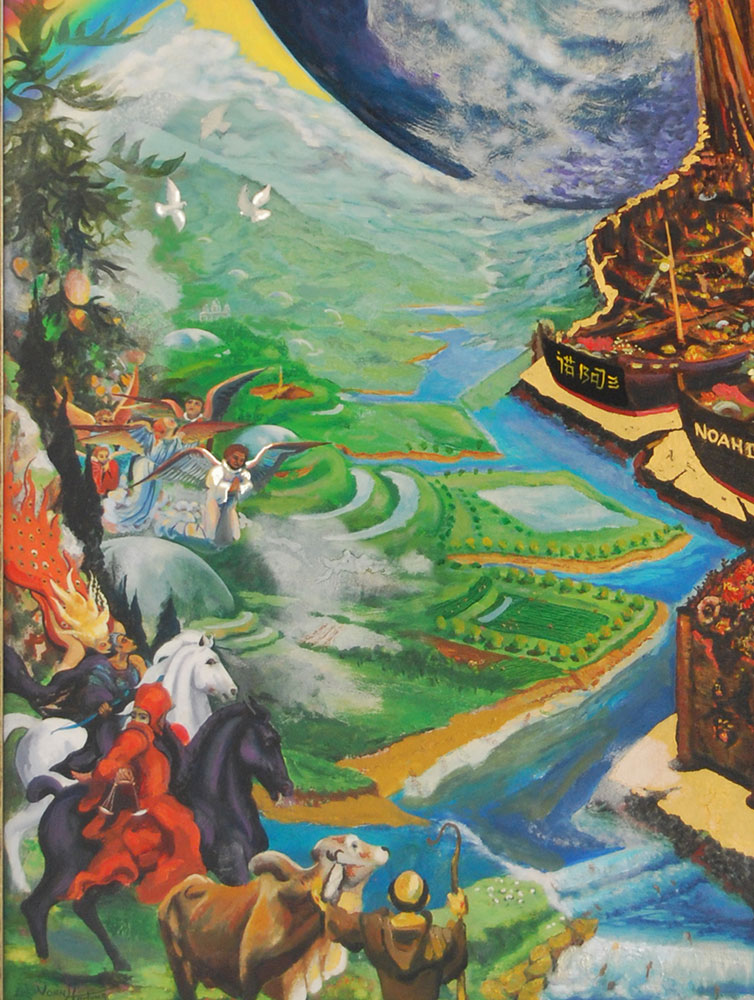
Haciendo contraste con este rostro infernal está el lado floreciente de la pintura que muestra un futuro simbolizado por el constante flujo de aguas vivas que nutren la creación, aguas del Bautismo, las que surgen del costado de Jesús.
Detail3 of painting "Así en la Tierra como en el Cielo" by AVonnHartung

Un mundo sostenible

Al lado de esta agua vemos el cultivo de la agricultura y aqua-cultura sostenible, así como edificios que se construyen en la tierra para preservar energía y para la protección de otros desastres naturales.

El paisaje es sereno y aparentemente escasamente poblado lo cual sugiere comunidades autosuficientes inteligentemente diseñadas donde el transito constante en las supercarreteras es innecesario. Es un mundo en armonía interna!

En medio de esta Visión Esperanzadora se ven un conjunto de ángeles que acompañan a Los Jinetes del Apocalipsis, que según avanzan son atajados por el Angel que (imaginamos) les susurra, ¡Esperen! La humanidad todavía tiene tiempo y la Voluntad libre para cambiar sus proceder y hacer la voluntad de Dios!

Detail4 of painting "Así en la Tierra como en el Cielo" by AVonnHartung

Esto sólo puede suceder si renunciamos a nuestra fantasía voraz de crecimiento económico ilimitado y de ser todopoderosos y separados de la Naturaleza.
Tenemos que lograr encontrar la sabiduría y acoger la visión de San Francisco, la oración que Su Santidad hace por nosotros en su encíclica Laudato Si’, palabras de Amor y Sabiduría, que responden “al clamor de la tierra y al clamor de los pobres” [L.S. 49] y la oración que el mismo Cristo nos enseñó en el Padre Nuestro,

“Venga a nosotros Tu Reino, Hágase Tu Voluntad así en la Tierra como en el Cielo…” que nos urge a cambiar nuestro proceder, hacer Justicia, vivir en la relación correcta con los demás y la Naturaleza, en armonía con nuestro planeta, la creación de Dios y el regalo que nos hace a todos, “Nuestra Casa Común” [L.S].
Amén.

Traducción por Norma T. Diaz Camacho


En Abril de 1996, esta pintura “Hágase tu Voluntad” estaba expuesta en la Iglesia San Ignacio, donde presenté una charla con reflexiones (publicada en “El Nuevo Dia” 22 de abril 1996) sobre lo que me motivó a crear esta obra.


UnaCuestiónDeMoral_pinturaHagaseTuVoluntad

NOTA: Esta pintura ha sido publicada en el libro de texto católico: “The Church Foundations and Mission” (Los fundamentos y la misión de la Iglesia), High School Framework Course 4 (Curso Marco de la escuela secundaria 4), por Carrie J. Schroeder, MDiv, EdD ©2020 St. Mary’s Press.

Esta pintura ha sido expuesta en el Centro de Bellas Artes Alejandro Cruz Ortiz, Guaynabo, Puerto Rico, del 26 de marzo al 26 de junio de 1998; en el Departamento de Estado, San Juan, Puerto Rico, durante la Cuaresma de 2011; en la Universidad del Este Ana G. Méndez, Carolina, Puerto Rico, durante la Cuaresma de 2005; en la Parroquia San Ignacio de Loyola, San Juan, Puerto Rico, en 2023; y en numerosos espacios públicos e iglesias de Puerto Rico.


Compre una impresión giclée de esta pintura.


On Earth as in Heaven

On Earth as it is in Heaven

In response to our Holy Father Pope Francis’s call to dialogue and action on Climate Change in his Encyclical Laudato Si’ On Care for Our Common Home, published in 2015, I offer this metaphorical painting, On Earth as it is in Heaven,  as a visual prayer to raise consciousness and to encourage dialogue

[Leer en Español]

The title of the painting, “On Earth as it is in Heaven,”  is taken from the prayer Jesus taught us. That is, the Lord’s Prayer: Thy Kingdom Come, Thy Will Be Done, On Earth as it is in Heaven.

The painting is rhetorical in concept and presents us with only two possibilities.

One in harmony with God’s Creation. In other words, a future of justice, peace, and sustainability in the natural world. Conversely, the other is plunder, chaos, and endless war—subsequently, an ultimate collapse of nature and life on our planet, as we know it.

Moreover, the painting poses a question to the viewer, each one of us, regardless of our religion or beliefs. Which future do we want to live in, leave to our children and future generations?

Continue reading

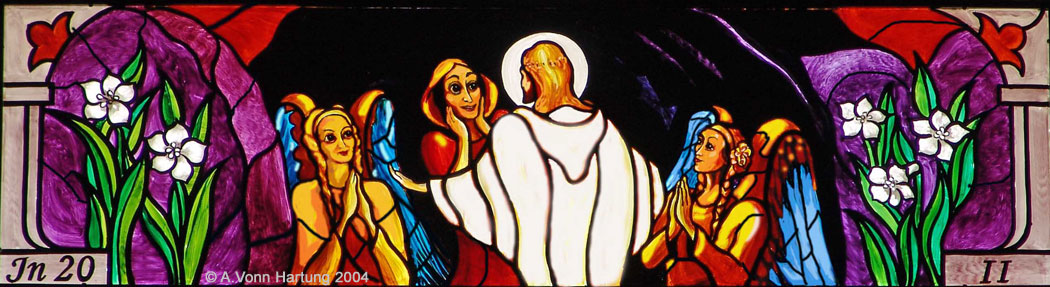
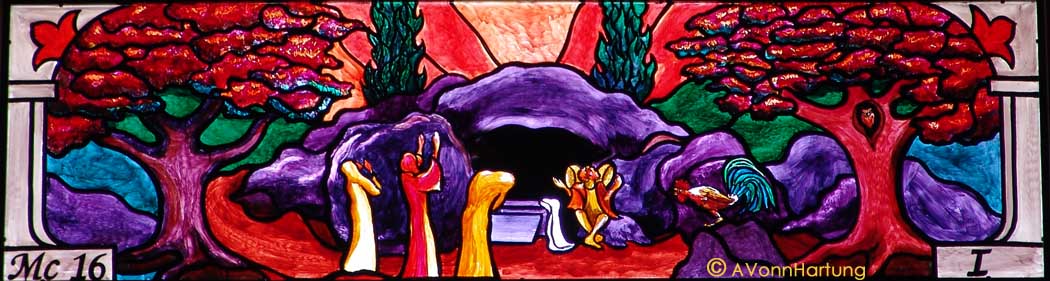
And they saw the tomb was empty…(Mark 16)

When Jesus was resurrected, becoming for us the Christ, in that moment, the world was changed forever for his believers.

Earth burst into blossom. Earth glowed with light in the deep night of time.

Everything, all creation, was illuminated with divine light, hope.

AS SUCH, I PAINTED THE STATIONS OF THE RESURRECTION (Via Lucis-The Way of Light)

And they saw the tomb was empty_ViaLucis1_painting on glass by AVonnHartung
And they saw the tomb was empty.

The intense color is meant to bring this miraculous change into our consciousness.

The colors are super infused with hue. Each color becomes the heightened essence of itself. To the uninformed eye, these “stained glass” windows on the Resurrection might look fantasia-like. They’re meant to be, however,  simple in form and basic in color.


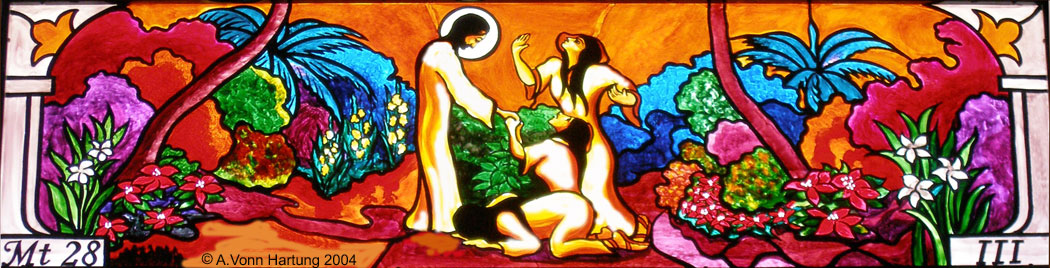
"Mary Magdalene encounters the risen Jesus" ViaLucis2 painting on glass by AVonnHartung
Mary Magdalene encounters the risen Jesus.

The figures show emotion in their gestures, their exaggerated movements. This is to show that reality was turned on its head.

Something so unbelievable had occurred that it changed consciousness forever.

The world became full of hope and meaning because death had lost its power and its grip on humanity.

Hallelujah! He has risen!

"After the Resurrection Jesus appears to the women" ViaLucs3 painting on glass by AVonnHartung
After the Resurrection, Jesus appears to the women

These 14 Stations of the Resurrection (Via Lucis) adorn the upper reaches of the nave of Capilla San Juan Bosco in Orocovis (Barrio Gato), Puerto Rico. Padre Jorge Santiago Cartagena, SDB, commissioned them. Twelve similar windows were also commissioned by Padre Jose Luis Gómez, SDB for the church San Juan Bosco in Villa Palmeras, San Juan.

In 1998 Father Sabino Palumbieri, Salesian priest and professor of theological anthropology in Rome, “proposed the creation of a new set of stations [to complement the Stations of the Cross] centered upon the resurrection and the events following it to emphasize the positive hopeful aspect of the Christian story which, though not absent from the Stations of the Cross, is obscured by their emphasis upon suffering. The first major public celebration of this devotion was in 1990…”
It was officially sanctioned by the Vatican in 2001. (From Wikipedia-“Stations of the Resurrection”)

Contemplative Images for Holy Week

View a video of these Stations of the Cross, accompanied by sacred music

View video The Passion of our Lord

Ver video La Pasión de nuestro Señor


Read in Spanish

 The reason for the use of Sacred Art in the Church is to make visible what is invisible, to bring us to a more heightened state of awareness and connection with God and His Saints that we might share more fully in His Glory and Love for us, that we might go forth and DO HIS WILL.

Sacred Places of Jesus’ Life, Death and Resurrection have always been venerated – early pilgrims retraced the Way of the Cross. So it was that the pilgrims brought back from The Holy Land the idea of recreating those sacred places and events to share with the faithful of their home churches.

It is said that Saint Francis of Assisi began the practice of the Stations of the Cross. It then spread throughout Italy and Europe. It was his practice to reproduce in a realistic way the events of our Lord’s life and deeds (an example, is his reported installation of the stable and manger with live animals and people in commemoration of the birth of Jesus).

In a similar way I conceived these Stations of the Cross to bring immediacy to the Passion of our Lord.

Each one measures 4-ft x 8-ft. This is because of the cavernous size and interior simplicity of the nave of the church, Santa Rosa de Lima, in the town of Guaynabo, Puerto Rico.  Intimacy was achieved by the use of local people as models and customs, so that the faithful might better identify with the trials that Our Lord and Savior suffered and died for because of His Love for us.

Buy giclee prints of these Stations


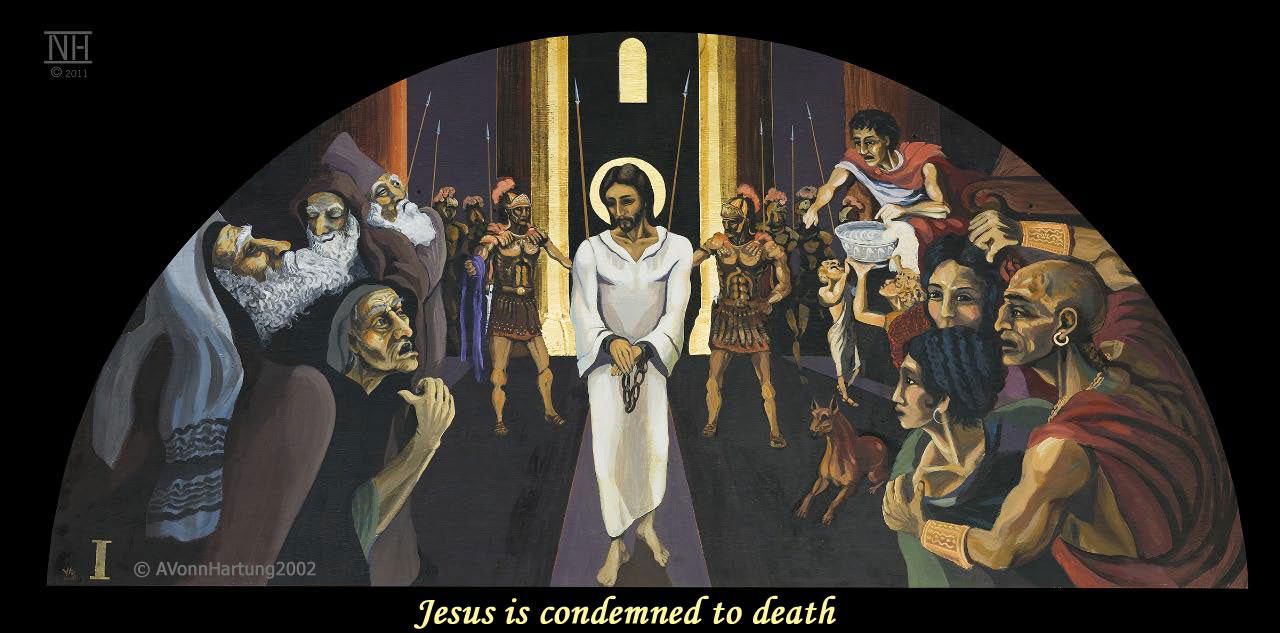
Jesus is condemned to death. ViaCrucis Station 1 painting by AVonnHartung

Here we see Jesus, centered, surrounded by many but COMPLETELY alone, only those admitted from the status quo on both sides (although we see Flavia, wife of Pilate and perhaps Nicodemus who represent a small group of inside sympathizers).

In the midst of a crowded room He is a lonely figure. All signs point to Him, the columns, the center aisle and all who gesture, single Him out in accusation. He is The One! The cause of all their troubles, indignation and hatred! He must DIE!


Continue reading

Television Interview with A.Vonn Hartung

Update: See the video interview

EWTN (Eternal Word Television Network) will be airing an interview on March 5, 2015 with A.Vonn Hartung about Blessed Carlos Manuel Rodríguez Santiago, and Vonn’s experience painting the portrait that is at the Vatican.

THE CHURCH IN PUERTO RICO (30 minute duration)
Thursday March 5 at 3:00 am & 6:30 pm Eastern Time
[Puerto Rico time: 4:00 am and 7:30 pm]

The first 15 minutes of the program is a conversion story about a young man who turned his life around and is now studying for the priesthood; the second part is the interview with Vonn.

The EWTN program can be seen on–
Liberty Cablevision Channel 103 ( in Puerto Rico)
Dish Network Channel 261
DirecTV Channel 350
ROKU

Please visit the EWTN website for channel listings in your local area.
http://www.ewtn.com

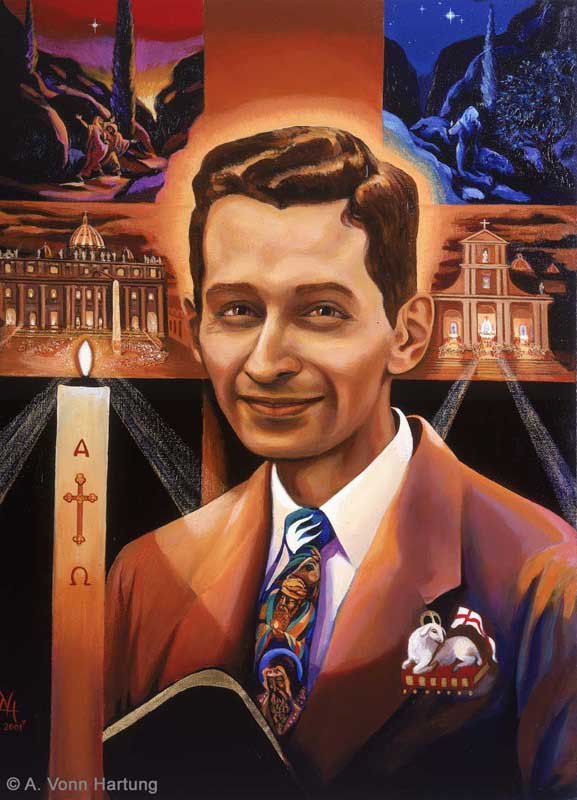
Blessed Carlos Manuel Rodríguez Santiago portrait by AVonnHartung_at Pontifical North American College Vatican
“Blessed Carlos Manuel Rodríguez Santiago”
Oil portrait-
at Pontifical North American College, Vatican


This is the oil portrait of Blessed Carlos Manuel Rodriguez Santiago by A.Vonn Hartung © 2001, presented to the Pontifical North American College at the Vatican on the occasion of the beatification of Carlos Manuel on 29 april 2001, and is on permanent display there in the Hall of Saints. Learn more

Buy a giclee print of this painting


St. John Apostle and Evangelist

(Scroll down for Spanish text)

In celebration of St. John Apostle and Evangelist

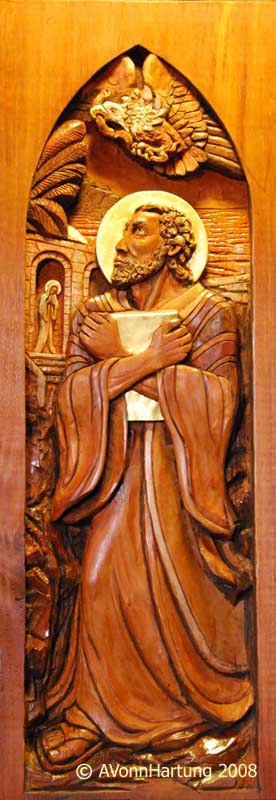
St. John Evangelist high relief wood sculpture by AVonnHartung for St. Paul's Catholic Church (Pensacola, Florida)
St. John Evangelist” wood sculpture high relief by AVonnHartung for St. Paul’s Catholic Church (Pensacola, Florida)

Today is the Feast Day of St. John the Apostle and Evangelist.

He is shown here with St. Mary, whom he cared for after our Lord’s crucifixion (Jn 19:26, 27), at Ephesus in Turkey, the Isle of Patmos on the horizon, imprisoned and wrote Revelation.
He embraces his gospel to his heart, bringing to mind the Cross and Passion of our Lord. Significantly, his crossed arms define the shape of a chalice (the sacred blood) and an hourglass. Indeed, it reminds us that Christ is the Alpha and the Omega.

Above the saint flies the eagle, John’s symbol of vision and highest inspiration. Specifically, it carries away a serpent because, according to legend, Emperor Domitian once spiked the saint’s wine with poison. Subsequently and miraculously, it turned into a snake and slithered out of the cup.

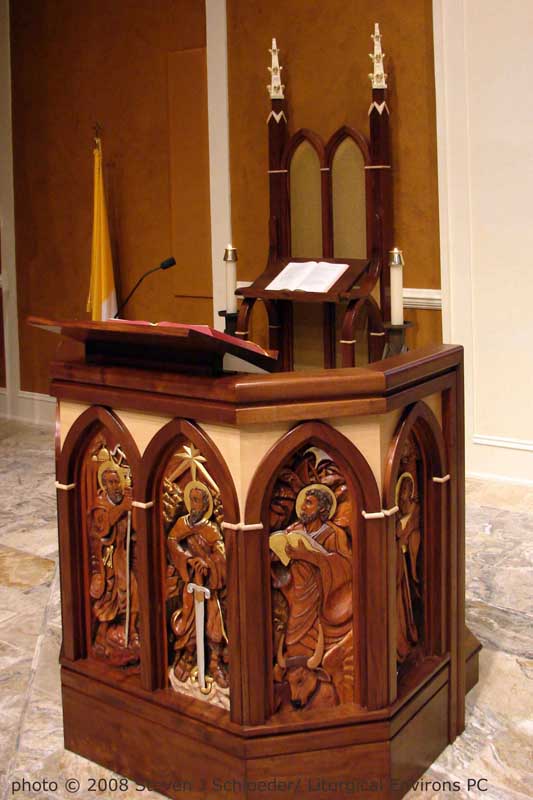
High relief wood carvings of 6 saints by Vonn Hartung, in ambo at St. Paul's Catholic Church, Pensacola, Florida (photo by Steven Schloeder/Liturgical Environs PC)
High relief wood carvings of 6 saints by Vonn Hartung, in ambo at St. Paul’s Catholic Church, Pensacola, Florida
(photo by Steven Schloeder/Liturgical Environs PC)


This high relief wood sculpture, St. John Apostle and Evangelist is12-inches x 33-inches x 3-inches. It is one of six saints carved by A.Vonn Hartung. Pastor Doug Halsema commissioned them for the Ambo of St. Paul’s Catholic Church in Pensacola, Florida. Dr. Steven Schloeder of Liturgical Environs PC was the liturgical consultant.

The saints are all directed towards the center of the Ambo, as though they are again listening to and reliving the truth and reality of Christ Jesus, that because of them and through them, the gift of the Holy Spirit continues to live in us in the Liturgy of the Word.

A.Vonn-Hartung_six-saints-wood-carvings(1)


Working with Vonn on the iconography and formal expression of the new ambo at St. Paul’s in Pensacola, Florida, was an enriching experience. Vonn brought forth a powerful new interpretation of a classical iconographic theme. The four Evangelists surrounding the figures of Saints Peter and Paul create a “sacra conversazione” of dialogue among themselves, with the Lord, who proclaims the Gospel, and with the congregation listening to the Lord proclaimed in the Gospel. The power of his figures that capture the spirit of the Evangelists and the Apostles of Rome can only come from deep contemplation and resonance with the subjects, and a profound mastery of his art.” —

Dr. Steven J. Schloeder, architect, author of Architecture in Communion (Ignatius Press)

***********************************************

Español


St. John Evangelist high relief wood sculpture by AVonnHartung for St. Paul's Catholic Church (Pensacola, Florida)
 “San Juan Evangelista“, Escultura en madera en alto relieve, obra de AVonn Hartung, para la Iglesia Católica, San Pablo (Pensacola, Florida).

Hoy es el Día de Fiesta de San Juan Apóstol y Evangelista

Aquí se muestra con Santa María a quien le cuidaba después de la crucifixión de nuestro Señor (Jn 19:26, 27) en Éfeso, Turquía. La isla de Patmos está en el horizonte, donde fue encarcelado y escribió el Apocalipsis. Él abraza a su Evangelio a su corazón que nos recuerda la Cruz y de la Pasión de Nuestro Señor. Ademá, sus brazos cruzados definen la forma de un cáliz (la sagrada sangre) y un reloj de arena. Eso nos recuerda que Cristo es el Alfa y la Omega.

Por encima del santo vuela el águila, símbolo la visión y la más alta inspiración de San Juan. Se lleva una serpiente. Cuenta la leyenda que el emperador Domiciano envenenó el vino del santo. Entonces  milagrosamente se convirtió en una serpiente y se deslizó de la copa.

Esta escultura en madera de alto relieve (12 pulgadas x 33 pulgadas x 3 pulgadas) es uno de los seis santos tallados por A.Vonn Hartung para el ambón de la iglesia Católica de St. Paul en Pensacola, Florida, encargado por el Pastor Doug Halsema mediante Consultor Litúrgico Dr. Steven Schloeder de Liturgical Environs PC

High relief wood carvings of 6 saints by Vonn Hartung, in ambo at St. Paul's Catholic Church, Pensacola, Florida (photo by Steven Schloeder/Liturgical Environs PC)
High relief wood carvings of 6 saints by Vonn Hartung, in ambo at St. Paul’s Catholic Church, Pensacola, Florida
(photo by Steven Schloeder/Liturgical Environs PC)

Los santos están dirigidos hacia el centro del Ambón, como si estuvieran escuchando de nuevo y volviendo a vivir la verdad y la realidad de Cristo Jesús, que gracias a ellos a través de ellos el don del Espíritu Santo continúa viviendo en nosotros en la Liturgia de la Palabra.

“Trabajar con Vonn en la iconografía y la expresión formal del nuevo ambón de la iglesia de San Pablo en Pensacola, Florida, fue una experiencia enriquecedora. Vonn proyectó una nueva y poderosa interpretación de un tema iconográfico clásico. Los cuatro evangelistas que rodean las figuras de los santos Pedro y Pablo crean una “sacra conversazione” de diálogo entre ellos, con el Señor, que proclama el Evangelio, y con la congregación que escucha al Señor proclamado en el Evangelio. La fuerza de sus figuras, que capturan el espíritu de los evangelistas y los apóstoles de Roma, solo puede provenir de una profunda contemplación y conexión con los temas, y de un profundo dominio de su arte”. — Dr. Steven J. Schloeder, arquitecto, autor de Architecture in Communion (Ignatius Press)

Our Lady of Guadalupe with St. Juan Diego

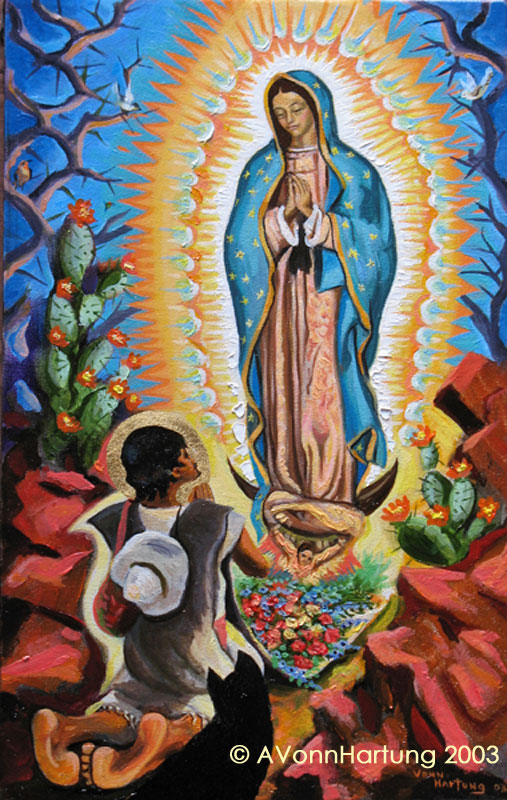
"Apparition of Our Lady of Guadalupe with St. Juan Diego" painting by AVonnHartung
“Apparition of Our Lady of Guadalupe with St. Juan Diego” painting by AVonnHartung

Today we celebrate the Feast of Our Lady of Guadalupe, Patroness of Mexico and Empress of the Americas…today December 12, the day that she left her image imprinted on Juan Diego’s tilma. (translation from La Palabra Entre Nosotros)

This painting also celebrates St. Juan Diego, whose Feast Day is December 9th.

In 2003 I was commissioned by Parroquia San Ignacio (9:30 Community) in San Juan, Puerto Rico, to paint “Our Lady of Guadalupe with St. Juan Diego” to be given as a gift to Father Donald Vega SJ, on the occasion of his 50th anniversary as a priest. (She is his personal patron saint)

I added a personal detail by including his dog Luigi in the foreground. Luigi and Lola were orphaned dogs taken in by Father Vega. They would lie down before the altar and in the first pew everyday as he celebrated mass.

Buy a giclee print of this painting


A brief history of Our Lady of Guadalupe.


Spanish translation follows

Continue reading

St. Luke the Evangelist

(Scroll down for Spanish text)

Today, October 18th, is the Feast Day of St. Luke the Evangelist, patron saint of physicians and artists.

On this occasion, I pay special homage to him with this wood sculpture.

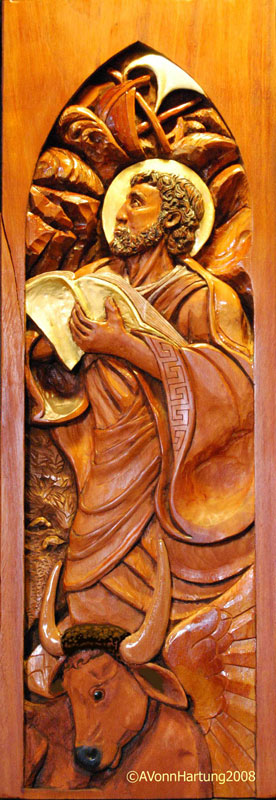
St. Luke high relief wood sculpture by AVonnHartung for St. Paul's Catholic Church (Pensacola, Florida)
St. Luke, high relief wood sculpture by AVonnHartung for St. Paul Catholic Church (Pensacola, Florida)

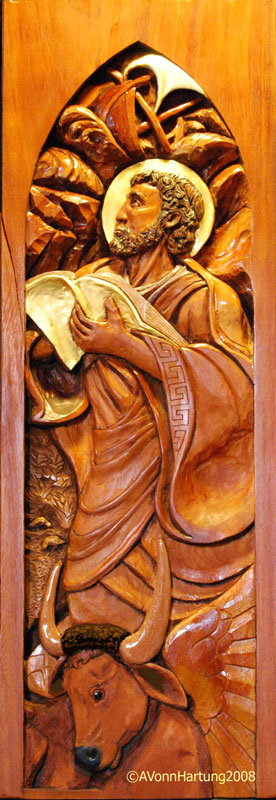
Artistically, I have placed St. Luke the Evangelist in the center of his mission.  In addition, I have conveyed the sense of harmony that the gift of the Holy Spirit has brought him.

Luke was St. Paul‘s companion and biographer. Additionally, he authored Acts of the Apostles, a continuation of his gospel. By the style of his hair and garments, I indicate his Syrian gentile origin of Greek lineage. I have juxtaposed Luke to the winged ox, symbol of sacrifice, patient servitude, and strength.  Additionally, I have portrayed the Parable of the Sower from his gospel (Lk 8:4-9).

The tempestuous backdrop witnesses to his shipwreck with Paul (Acts 27:13-42) and the many trials and tribulations he experienced struggling to keep pace with him on his missionary journeys. Luke holds his written witness in a book (gospel) that resembles a paperback, reflecting the dynamics of his perilous travels with Paul.

Luke studied the life and words of Jesus with utmost care, knew and relied upon witnesses to the actual events–including Mary and St. John–and devoted some time to speaking with the women who had traveled with Jesus. The Gospel [of Luke] is thus especially notable for the respect and attention it pays to women in the Church, in contrast to the role of women both in Jewish and pagan society…Luke stresses the mercy of God, documenting the merciful acts of Christ…Luke also devoted much attention–more than his fellow evangelists–to the interior life of prayer…” (OSV’s Encyclopedia of Catholic History, by Matthew Bunson, D.Min.)


High relief wood carvings of 6 saints by Vonn Hartung, in ambo at St. Paul's Catholic Church, Pensacola, Florida (photo by Steven Schloeder/Liturgical Environs PC)
High relief wood carvings of 6 saints by Vonn Hartung, in ambo at St. Paul’s Catholic Church, Pensacola, Florida
(photo by Steven Schloeder/Liturgical Environs PC)

This high relief wood sculpture (12-inches x 33-inches x 3-inches) is one of the six saints carved by A.Vonn Hartung for the Ambo of St. Paul’s Church in Pensacola, Florida, commissioned by Pastor Doug Halsema through  Liturgical Consultant Dr. Steven Schloeder of Liturgical Environs.

The saints are all directed towards the center of the Ambo, as though they are again listening to and reliving the truth and reality of Christ Jesus, that because of them and through them, the gift of the Holy Spirit continues to live in us in the Liturgy of the Word.


Here are large photos, including a bilingual description (Eng/Span) of the Ambo and all six saints 

A.Vonn-Hartung_six-saints-wood-carvings(1)


Six Carved Saints is a video of the artist explaining the symbolism of the carvings.


Working with Vonn on the iconography and formal expression of the new ambo at St. Paul’s in Pensacola, Florida, was an enriching experience. Vonn brought forth a powerful new interpretation of a classical iconographic theme. The four Evangelists surrounding the figures of Saints Peter and Paul create a “sacra conversazione” of dialogue among themselves, with the Lord, who proclaims the Gospel, and with the congregation listening to the Lord proclaimed in the Gospel. The power of his figures that capture the spirit of the Evangelists and the Apostles of Rome can only come from deep contemplation and resonance with the subjects, and a profound mastery of his art.”

Dr. Steven J. Schloeder, architect, author of Architecture in Communion (Ignatius Press)


****************************************

Español
 

Hoy, 18 de octubre, se celebra la festividad de San Lucas Evangelista, patrono de los médicos y artistas.

En esta ocasión le rindo un homenaje especial con esta escultura de madera.

San Lucas, escultura en madera de altorrelieve, de AVonn Hartung, para la Iglesia Católica, St Paul (Pensacola, Florida).

Artísticamente, he situado a San Lucas Evangelista en el centro de su misión. Además, he transmitido la sensación de armonía que le ha brindado el don del Espíritu Santo.

Lucas fue el compañero y biógrafo de San Pablo. Además, fue autor de los Hechos de los Apóstoles, una continuación de su evangelio. Por el estilo de su cabello y sus vestimentas, indico su origen gentil sirio de linaje griego. He yuxtapuesto a Lucas con el buey alado, símbolo de sacrificio, servidumbre paciente y fuerza. Además, he retratado la parábola del sembrador de su evangelio (Lc 8,4-9).

El tempestuoso telón de fondo da testimonio de su naufragio con Pablo (Hechos 27:13-42) y de las muchas pruebas y tribulaciones que experimentó mientras luchaba por seguir su ritmo en sus viajes misioneros. Lucas presenta su testimonio escrito en un libro (evangelio) que parece un libro de bolsillo, reflejando la dinámica de sus peligrosos viajes con Pablo.

“Lucas estudió la vida y las palabras de Jesús con sumo cuidado, conoció y se basó en testigos de los hechos —incluyendo a María y San Juan— y dedicó tiempo a hablar con las mujeres que habían viajado con Jesús. El Evangelio de Lucas es, por lo tanto, especialmente notable por el respeto y la atención que presta a las mujeres en la Iglesia, en contraste con el papel de la mujer tanto en la sociedad judía como en la pagana… Lucas enfatiza la misericordia de Dios, documentando los actos misericordiosos de Cristo… Lucas también dedicó mucha atención —más que sus compañeros evangelistas— a la vida interior de oración.”.. (Enciclopedia de Historia Católica de la OSV, por Matthew Bunson, D.Min.)

Esta escultura de madera en alto relieve (12 pulgadas x 33 pulgadas x 3 pulgadas) es uno de los seis santos tallados por A. Vonn Hartung para el ambón de la iglesia de San Pablo en Pensacola, Florida, encargado por el pastor Doug Halsema a través del consultor litúrgico Dr. Steven Schloeder de Liturgical Environs.

Tallas de madera en alto relieve de Seis Santos, obra de Vonn Hartung, en el ambón de la Iglesia Católica de St. Paul, Pensacola, Florida (foto de Steven Schloeder/Liturgical Environs PC)

Los santos están todos dirigidos hacia el centro del Ambón, como si nuevamente escucharan y revivieran la verdad y la realidad de Cristo Jesús, que por ellos y a través de ellos, el don del Espíritu Santo continúa viviendo en nosotros en la Liturgia de la Palabra.

Here are large photos, including a bilingual description (Eng/Span) of the Ambo and all six saints 

A.Vonn-Hartung_six-saints-wood-carvings(1)

Six Carved Saints es un vídeo del artista que explica el simbolismo de las tallas.


“Trabajar con Vonn en la iconografía y la expresión formal del nuevo ambón de la iglesia de San Pablo en Pensacola, Florida, fue una experiencia enriquecedora. Vonn creó una nueva y poderosa interpretación de un tema iconográfico clásico. Los cuatro evangelistas que rodean las figuras de los santos Pedro y Pablo crean una “sacra conversazione” de diálogo entre ellos, con el Señor, que proclama el Evangelio, y con la congregación que escucha al Señor proclamado en el Evangelio. La fuerza de sus figuras, que capturan el espíritu de los evangelistas y los apóstoles de Roma, solo puede provenir de una profunda contemplación y conexión con los temas, y de un profundo dominio de su arte”. —Dr. Steven J. Schloeder, arquitecto, autor de Architecture in Communion (Ignatius Press)


“The Life and Prophecy of St. John the Baptist”

“There was a man sent from God, whose name was John. The same came for a witness, to bear witness of the Light, that all men through him might believe. He was not that Light, but was sent to bear witness of that Light…. He said, I am the voice of one crying in the wilderness, Make straight the way of the Lord, as said the prophet Isaiah.” (John 1:6-8, 23)

(Scroll down for Spanish text)

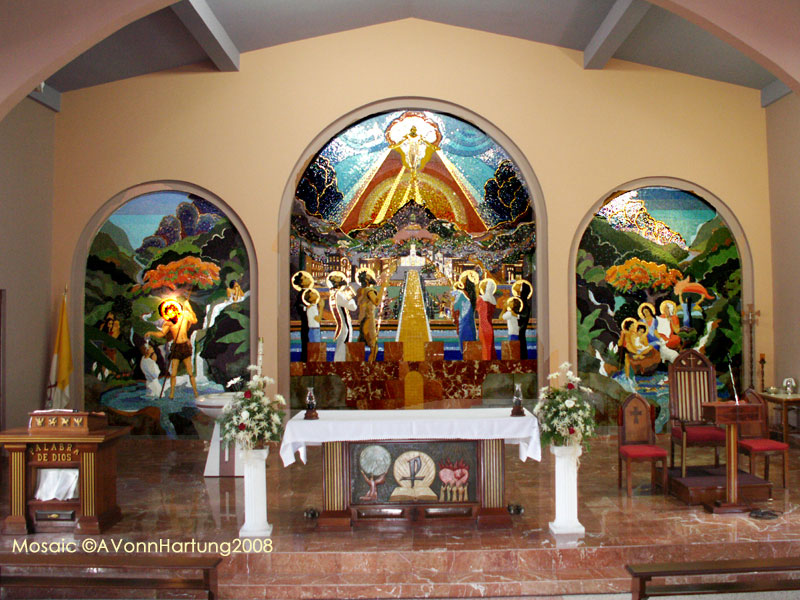
Today as the Catholic Church commemorates the Feast Day of the Martyrdom of St. John the Baptist, I present this mosaic mural which depicts his life and prophecy in the sanctuary of Parroquia San Juan Bautista in the central mountain town of Orocovis, Puerto Rico.

"The Life and Prophecy of St. John the Baptist" mosic mural by AVonnHartung in Orocovis, Puerto Rico
“The Life and Prophecy of St. John the Baptist” mosaic mural byAVonnHartung in Orocovis, Puerto Rico

Conceived in three arches which represent the Holy Trinity, the story of St. John the Baptist is expressed across time in the sanctuary of Christ’s church and includes the priest and congregation today in the fulfillment of sacred liturgy. When viewed from the rear of the Church during Mass, the servers and congregation are seen as completing the work of art.


Continue reading